2026-10-19
The migration of the Jews throughout history
Location: The world
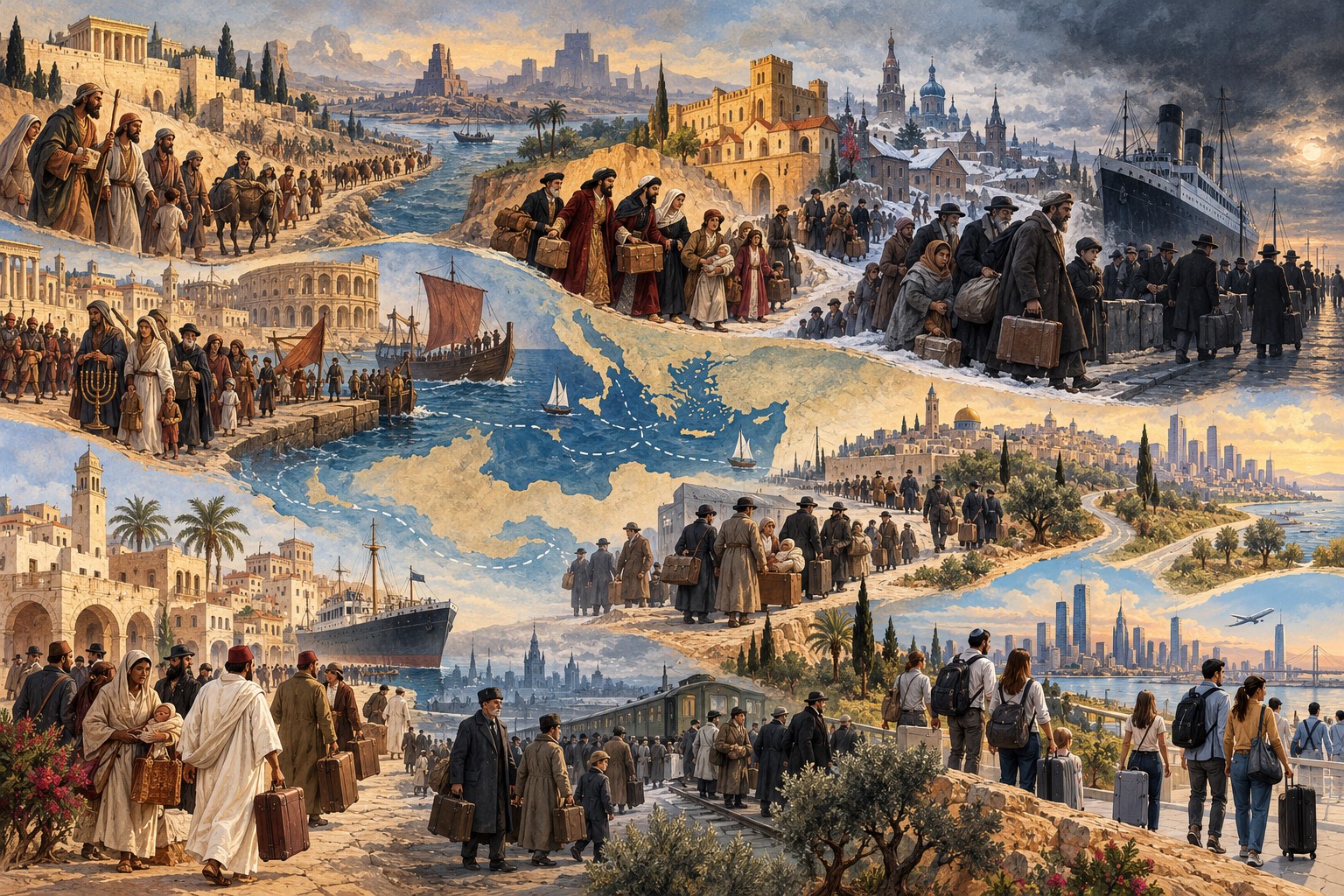
JEWISH EMIGRATION: FROM THE ANCIENT DIASPORA TO CONTEMPORARY FLOWS
Introduction
Jewish emigration, often defined as Diaspora, is a millennial phenomenon characterized by forced movements, expulsions and, more rarely, periods of voluntary migration. The history of the Jewish people is deeply linked to the search for safe places in which to preserve their religious and cultural identity.
Over the centuries, persecutions, conflicts, political changes and economic transformations have led to successive waves of migration. Since the Second World War, these movements have taken on new and complex forms, influenced by the birth of the State of Israel, decolonization, the Cold War, Middle Eastern conflicts, anti-Semitism and socio-economic factors.
THE GREAT PHASES OF JEWISH EMIGRATION
587 BC – Babylonian exile
After the fall of Jerusalem, part of the Jewish population was deported to Mesopotamia, mainly to Babylon.
70-135 AD – Roman destruction of Jerusalem and Diaspora
The destruction of Jerusalem and the Second Temple determined the dispersion of Jewish communities in the Mediterranean basin and in Europe.
1492 – Expulsion from Spain
The Decree of Alhambra required Jews to convert to Catholicism or leave the kingdom. The main destinations were the Ottoman Empire, North Africa and Central Europe.
End of the 19th and beginning of the 20th century – Escape from the tsarist pogroms
Persecutions in the Russian Empire pushed millions of Jews to the United States, Western Europe, and Palestine.
1933-1945 – Nazism and Shoah
Nazi persecution resulted in attempts to escape to the Americas, the United Kingdom and other territories. After 1948, Israel became a major destination for survivors and refugees.
THE MOST TRAGIC EVENTS
The Destruction of Jerusalem and the Roman Diaspora
After the first Jewish revolt, Roman legions led by Titus destroyed the Second Temple in Jerusalem in 70 AD. Hundreds of thousands of Jews were killed, enslaved or deported in various areas of the Roman Empire. This event marked a decisive phase in the fragmentation of the Jewish communities of the ancient world.
Expulsion from Spain
In 1492 the Catholic kings Ferdinand and Isabella signed the Decree of Alhambra. The Jews were ordered to convert or leave the kingdom within a few months. Many Sephardic Jews lost their property; some died during the journey or were plundered by those who were supposed to transport them to safety.
Pogroms in the Russian Empire
Between 1881 and 1921, the Russian Empire was crossed by violent anti-Semitic waves, often tolerated or encouraged by the tsarist authorities. Massacres such as the Kishinev pogrom of 1903 contributed to the emigration of over two million Eastern European Jews, mostly to the United States.
The Shoah and the tragedy of refugees
Between 1933 and 1945, Nazi Germany attempted to exterminate Europe's Jewish population. In addition to the systematic murder of approximately six million Jews, this period was marked by the refusal of numerous countries to accept refugees.
In 1939 the liner St. Louis, with over nine hundred German Jewish refugees on board, was rejected first by Cuba and then by the United States. The ship had to return to Europe and hundreds of its passengers subsequently died in extermination camps.
In 1938, during the Évian Conference, delegates from thirty-two countries discussed the problem of Jewish refugees. However, nearly all participating nations, including the United States and the United Kingdom, refused to significantly increase their immigration quotas.
THE SECOND WAR AND THE RECONFIGURATION OF THE DIASPORA
The European refugee crisis
In 1945, approximately 250,000 Holocaust survivors were in camps for displaced persons in Germany, Austria and Italy. Many attempted to return to their countries of origin, but new episodes of anti-Semitic violence, such as the Kielce pogrom of 1946, demonstrated how difficult it was to rebuild a life in Eastern Europe.
Bericha and the birth of Israel
Through the clandestine organization Bericha, whose name means "escape", hundreds of thousands of Jews crossed Europe on foot or on makeshift boats. Despite British naval blockades and the internment of over 50,000 people in camps in Cyprus, the birth of the State of Israel in May 1948 paved the way for mass immigration, known as Aliyah.
The exodus from Arab and Muslim countries
Between the 1950s and 1970s, following the Arab-Israeli conflict and growing local hostilities, approximately 850,000 Jews abandoned communities that had been present for centuries in the Middle East and North Africa. Expulsions, violence, discrimination and confiscations of assets affected, among others, Iraq, Yemen, Egypt, Libya and Morocco. Many refugees settled in Israel; others reached Europe, especially France.
The fall of the Soviet Union
In the 1990s, with the collapse of the communist bloc, over a million Soviet Jews left Russia and the republics of the former Soviet Union. The main destinations were Israel and the United States.
JEWISH MIGRATIONS IN THE 21ST CENTURY
In the 21st century, Jewish migratory flows present different and sometimes opposing dynamics. On the one hand, immigration to Israel continues; on the other hand, the emigration of Israeli citizens to other countries has increased. Geopolitical tensions, security, cost of living, anti-Semitism and professional opportunities are among the main factors.
EMIGRATION FROM ISRAEL
The negative migratory balance
If for decades Israel has been one of the main destinations for Jewish immigration, in recent years a significant outgoing movement has also developed. Some studies estimate that approximately 45,000-50,000 Israelis have chosen to live abroad for periods longer than a year.
The main causes
The reasons include internal political instability, the continuation of conflicts in Gaza and with Lebanon after the attacks of 7 October 2023, the cost of living and concerns about the democratic future of the country.
The brain drain
A significant part of the emigrants is made up of highly qualified professionals: doctors, academics, engineers, entrepreneurs and workers in the technology sector. Many have dual citizenship or European roots. The main destinations include the United States, Canada and major cities in Western Europe.
THE MAIN EUROPEAN DESTINATIONS
Cyprus and Greece
Cyprus and Greece have become rapidly growing destinations thanks to their geographic proximity to Israel, lower costs of living and some favorable tax policies. These countries have attracted technology companies, entire work groups, and families who want to remain close to relatives living in Israel.
Berlin
For over a decade, Berlin has attracted young Israelis, artists and innovation professionals. Despite the complex history of the twentieth century, the city is perceived as an international cultural center, relatively accessible and open.
London
London is a major destination for those working in the finance, international law and corporate sectors. The spread of the English language and the presence of a historic and structured Jewish community strengthen its attractiveness.
THE INCREASE IN FLOWS FROM WESTERN EUROPE TO ISRAEL
In parallel with emigration from Israel, the number of Western European Jews considering moving to the country has grown.
The increase in incidents of anti-Semitism, intensified by tensions linked to Middle Eastern conflicts, has pushed numerous people to consider expatriation. In some periods, France has recorded a strong acceleration of Aliyah. Data from the Jewish Agency for Israel shows significant spikes in immigration from Western Europe.
FLOWS FROM EASTERN EUROPE
The war in Ukraine has reopened an emergency migratory channel from Eastern Europe. Tens of thousands of Ukrainian citizens of Jewish origin have left the war zones. Many Russian Jews have also left the Russian Federation due to economic sanctions, the authoritarian climate and fear of military mobilization.
THE JEWISH COMMUNITY IN ITALY
Rooting and stability
The Italian Jewish community is one of the oldest in the world and shows a strong ability to take root. There is no mass emigration to Israel comparable to that observed in France. Transfers are often motivated by religious, study or family reunification reasons.
Security
Attention to security remains high around synagogues, schools and Jewish cultural centers, especially after the global increase in anti-Semitic incidents after 2023. However, cooperation with law enforcement contributes to a perception of protection that limits outgoing flows.
Incoming flows
Italy also records a small but constant arrival of young Israelis, attracted by universities, in particular the faculties of Medicine, Architecture and Design, and by opportunities in the culinary and tourism sectors.
THE SOCIO-ECONOMIC IMPACT OF THE BRAIN DRAIN FROM ISRAEL
The technology sector
The Israeli economy is significantly dependent on technology exports. The departure of engineers, programmers and entrepreneurs to the United States or Europe can slow down innovation, reduce foreign investments and reduce tax revenues generated by the technology sector.
The healthcare system
The emigration of medical specialists and university researchers is a further source of concern. The Israeli healthcare system, under strong logistical and psychological pressure from prolonged conflicts, may suffer from staff shortages in areas such as surgery, psychiatry and emergency medicine. In the medium term, the loss of these professionals could lengthen waiting times and reduce assistance capacity.
Sources for this report:
External link
External link
External link
External link
External link
External link
External link
External link
External link
External link
External link
External link
External link
External link
External link
External link
External link
External link
External link
External link
External link
External link
External link
External link
External link
External link
 External link