1912-04-14
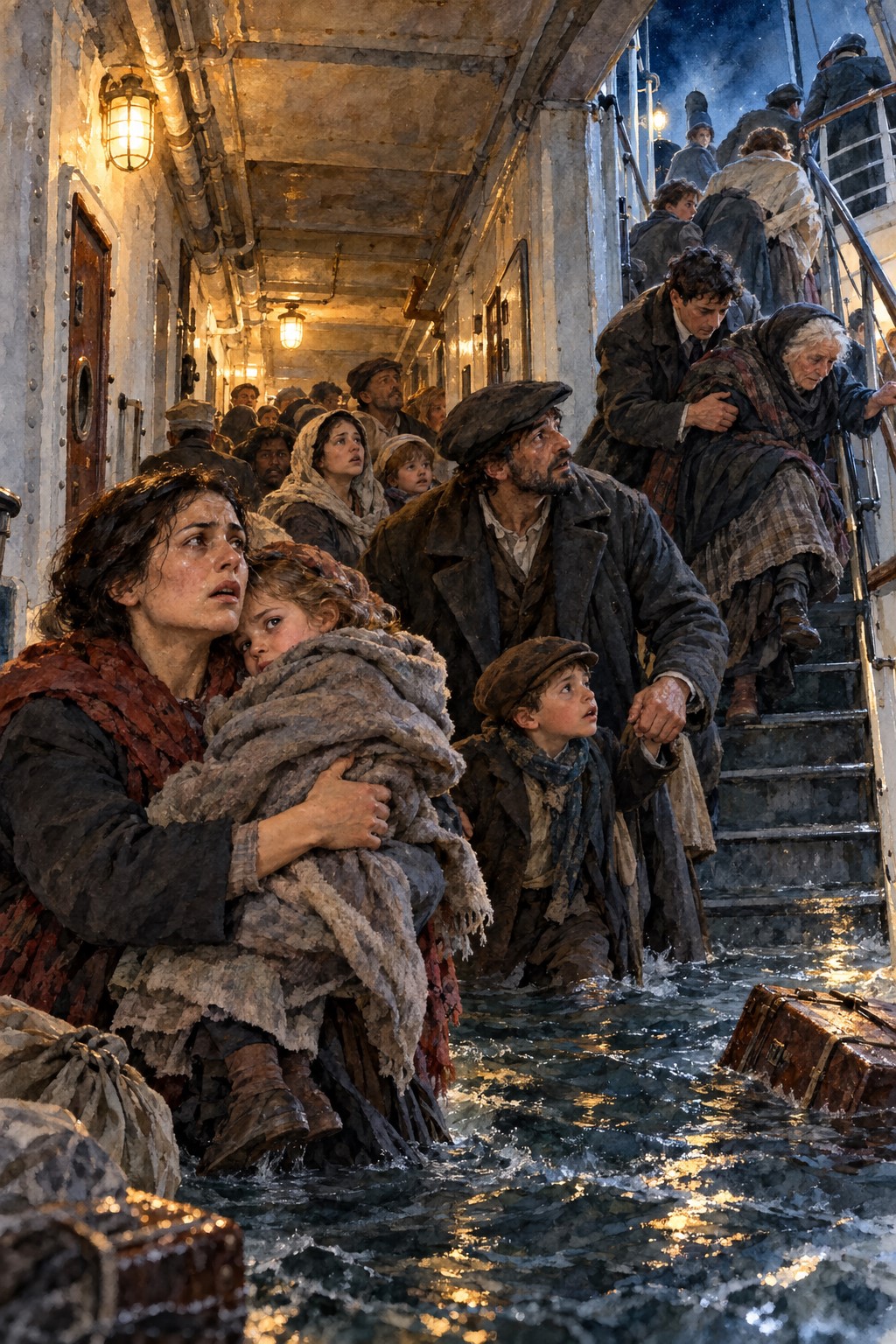
The sinking of the Titanic: third class was crowded with emigrants from all over the world.
Location: Titanic's recorded position at impact was 41°46′N 50°14′W. The wreck was found at 41°43′N 49°56′W.
The ocean liner RMS Titanic, belonging to the Olympic class of the White Star Line shipping company, brand new and engaged in her maiden voyage (from Southampton to New York, via Cherbourg and Queenstown), had a violent collision with an iceberg at 23:40 (time of the ship) on Sunday 14 April 1912. The impact caused the opening of some leaks under the waterline, flooding the bow locker and 5 of the watertight compartments of the transatlantic, which sank 2 hours and 40 minutes later (at 2 :20 of April 15) breaking into two sections. In the sinking, 1490 to 1635 of the 2223 people on board lost their lives, including 892 crew members; only 705 people managed to save themselves (some of whom died soon after being taken aboard the Carpathia).
There were just over 2,200 passengers and crew on board the vessel. Many passengers had previously booked on other ships and were diverted to the Titanic due to a coal strike. In the second class people of the middle class traveled, such as clerks, teachers and merchants, while the third class was crowded with emigrants from all over the world, assisted by the on-board interpreter.
During the RMS Titanic's maiden voyage, third class accommodated approximately 710 passengers (out of 1,006 available berths), consisting primarily of emigrants from all over the world traveling to the Americas in search of a fresh start and a new life.
This diverse "sea of humanity" included entire families and young people traveling alone, united by hope yet divided by language and cultural barriers.
Characteristics of third class
Nationalities and origins: Dozens of different cultures converged in third class. The passengers included large numbers of Irish, Swedes, Finns, Syrians, Armenians, Italians, Russians, and Hungarians.
Language barrier: Since the vast majority of these migrants did not speak a word of English, the shipping company provided an onboard interpreter to assist them with communication and daily procedures.
Ticket cost: A third-class ticket cost between 7 and 30 pounds sterling at the time. For these families, the sum represented weeks or months of hard sacrifice and savings—often sent by relatives who had already emigrated to the United States.
Segregation and hygiene: Due to strict immigration regulations of the era, third class was rigorously separated from the other classes by physical barriers. This was intended to facilitate the medical inspections and mandatory quarantines required upon disembarkation—such as at Ellis Island—to prevent the spread of disease.
Impact during the sinking
When the ship collided with the iceberg on the night of April 14–15, 1912, the rigid structural segregation and the shortage of lifeboats sealed the fate of these passengers. Statistics from the sinking of the Titanic highlight a profound social disparity in survival rates:
Class | Passengers on Board | Casualties | Fatality Rate
First Class | ~329 | ~130 | 39.5%
Second Class | ~285 | ~166 | 58.2%
Third Class | ~710 | ~536 | 75.4%
Many migrants were trapped in the ship's lower corridors, unable to reach the upper decks in time, making third-class passengers the group that paid the highest price in terms of human lives.
Sources for this report:
External link
External link
External link
External link
External link
External link
External link
External link
External link
External link
External link
External link
External link
External link
External link
External link
External link
 External link